
US President Donald Trump has warned of possible further American action against a small island off the coast of Iran - home to a major oil terminal that is considered the country's economic lifeline.
In an interview with the Financial Times on Sunday, Trump said he wants to "take" Iran's oil and was considering seizing Kharg Island. But he added an operation "would mean we had to be there [in Kharg Island] for a while".
On 13 March, Trump said that US forces had "totally obliterated" every military target on the island, but that the US military had held off targeting its oil infrastructure.
Earlier this month, US news outlet Axios, quoting four sources with knowledge of the issue, said that the administration was considering plans to occupy or blockade the island to pressure Iran to reopen the Strait of Hormuz - one of the world's most important shipping channels, located south of Iran's coast.
Trump says he is considering seizing Iran's Kharg Island, as oil price rises
Why the Strait of Hormuz matters so much in the Iran war
Iran says its forces 'waiting' as US troops arrive in region
Will the US try to seize the island?

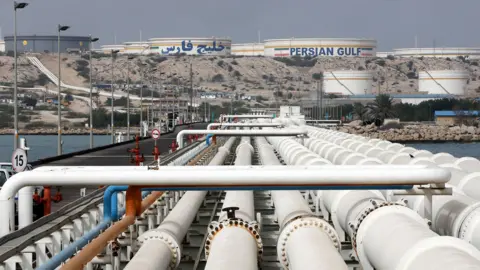 EPA
EPAThere has been speculation for some time about whether US forces would at some point attempt to take over Kharg Island.
Its seizure would not only choke off Iran's oil exports but could also provide a platform from which to carry out attacks against the mainland.
In the interview with the Financial Times, Trump said: "Maybe we take Kharg Island, maybe we don't. We have a lot of options."
He added: "It would also mean we had to be there [in Kharg Island] for a while... I don't think they have any defence. We could take it very easily."
Sources told the BBC's US partner CBS News that Pentagon officials have made detailed preparations to deploy ground forces into Iran.
Adding to that speculation, US Central Command said on Saturday that a further 3,500 US sailors and marines arrived in the Middle East as part of a unit led by the warship USS Tripoli.
Both the Pentagon and the White House have declined to offer comments on specific troop deployments or potential plans - but have repeatedly made clear that the option is available.
Taking the island would effectively cut off the IRGC's economic lifeline, affecting its ability to conduct war, security analyst Mikey Kay, from the BBC's Security Brief, says.
Aaron Maclean, host of the School of War podcast and a CBS national security analyst, said the US thinking was likely that the island could be seized and "used as leverage" to compel the Iranians to keep the strait open.
According to Maclean, any US operation to seize the island would be relatively small in size, but challenging. A US landing force would have to move considerable distances, either through naval vessels or as part of an airborne landing force.
Iran's parliament speaker Mohammad Bagher Ghalibaf, warned that his country's forces were "waiting for American soldiers" and they would "rain fire" on any US troops attempting to enter Iranian territory.
Previously, an Iranian military official told local media that shipping in the Red Sea would be targeted in the event of a ground invasion.
Iran has reinforced its defences on Kharg Island in recent weeks in response to the threat, including deploying additional military personnel and air defences, sources told CNN.
Tehran has sent additional shoulder-fired, surface-to-air missiles to the island and has laid traps including anti-personnel and anti-armour mines in the waters surrounding it, the website reported, citing "multiple people familiar with US intelligence".
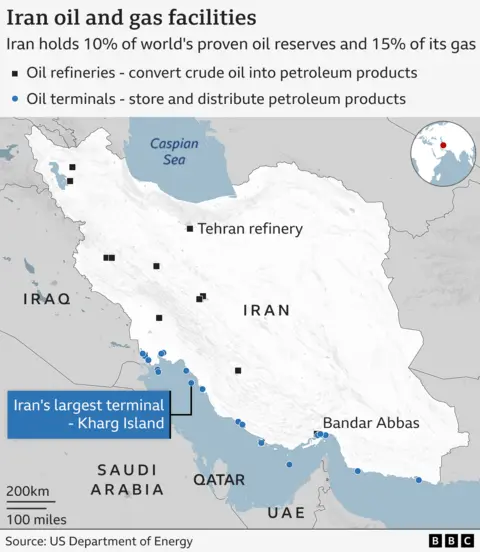
Why is Kharg Island important to Iran?
Kharg Island is a small rocky outcrop just 15 nautical miles (24km) off the coast of Iran.
Despite its size, it is one of the most critical pieces of Iran's energy infrastructure.
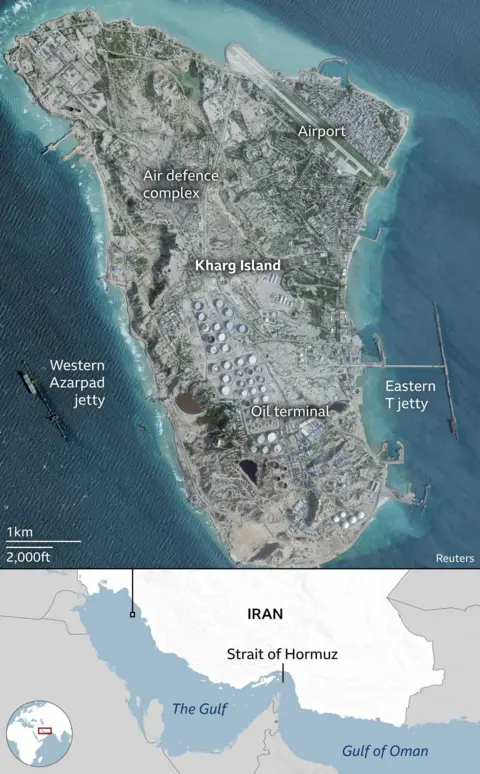
The US striking this small but vital island in the northern Gulf is like going for Iran's economic jugular vein.
Ninety percent of Iran's crude oil comes through a terminal on the island - transported through pipes from the mainland.
Trump has specifically mentioned the potential for targeting these pipelines, but said he had so far held off to avoid long-term damage to Iran's economy.
"We can do that on five minutes' notice. It'll be over," Trump said on 16 March. "Just one simple word, and the pipes will be gone too. But it'll take a long time to rebuild that."
Very large tankers - capable of carrying up to 85 million gallons of oil - are able to come up to the island's long jetties to pick up the oil. The island's coast is close enough to deep waters, unlike the shallower coast of the mainland.
The tankers then come back down the Gulf and out of the Strait of Hormuz, to China - the main buyer of Iranian oil.
A terminal for the export of Iranian oil, the island provides a major source of revenue for the Islamic Revolutionary Guard Corps (IRGC).
What did the US and Iran say about the 13 March attack?
Trump said on 13 March that the US Central Command (Centcom) had "executed one of the most powerful bombing raids in the History of the Middle East and totally obliterated every MILITARY target in Iran's crown jewel, Kharg Island".
He added that "for reasons of decency" he had "chosen NOT to wipe out the Oil Infrastructure on the Island".
Centcom said US forces had struck "more than 90 Iranian military targets on Kharg Island, while preserving the oil infrastructure".
The regional military command unit said it had destroyed naval mine storage facilities, missile storage bunkers and numerous other military sites.
Iranian state media reported that no damage was done to the island's oil facilities. The semi-official Fars news agency said US attacks targeted air defences, a naval base, an airport control tower and a helicopter hangar.
Ehsan Jahanian, political deputy to the governor of Bushehr province in southern Iran, said the process of exporting oil from Kharg was "fully under way" and "continuing without interruption", according to a report by the IRGC-affiliated Tasnim news agency.
Following the strikes, the country's military warned that oil and energy infrastructure belonging to firms working with the US would "immediately be destroyed and turned into a pile of ashes" if its energy facilities were attacked.
Why didn't the US target the island's oil facilities?
Military action to destroy the island's infrastructure would be hugely damaging to Iran.
It would also present a significant escalation to the conflict.
It would probably send global oil prices soaring even higher and could lead to Iran targeting more energy infrastructure across the Middle East.
A month into the war, Iran still has the capacity to launch large numbers of low-cost, high-explosive drones at its Gulf Arab neighbours as well as at shipping vessels.
It could, potentially, expand those targets to include vital infrastructure like desalination plants that provide drinking water for millions.
Under drone fire, exiled Kurds wait to confront Iranian regime
How the Iran war exposed cracks in Trump's Republican coalition
Why has Trump eased sanctions on Russian oil - and will it help Putin?
IranUnited StatesIran warRelated
Iran says its forces 'waiting' as US troops arrive in region
Fertiliser price rise risks 'inflation disaster'
How Trump and the oil markets move in sync: a tango in five charts
More from the BBC2 hrs ago

Oil rises above $115 and Asia shares slide as Iran war enters fifth week
It comes after Iran-backed Houthi rebels in Yemen joined the conflict by striking Israel over the weekend.
2 hrs ago3 hrs ago
Fuel tax halved and free public transport offered as war pushes up prices in Australia
Victoria and Tasmania are incentivising commuters not to drive in a bid to ease cost pressures.
3 hrs ago4 hrs ago
People 'spending less' during Iran war - businesses
Businesses in West Yorkshire say their costs are going up and people are spending less as the conflict continues.
4 hrs ago8 hrs ago
Partial government shutdown becomes the longest in US history
The 44-day funding lapse for the Department of Homeland Security has led to travel chaos at US airports.
8 hrs ago9 hrs ago
No Kings protests draw large crowds to rally against Donald Trump
One of the flagship No Kings rallies happened in Minnesota, where singer Bruce Springsteen performed to crowds.
9 hrs ago